The United States has ordered non-essential embassy staff and their family members to leave its mission in Abuja after raising concerns over the worsening security climate in Nigeria.
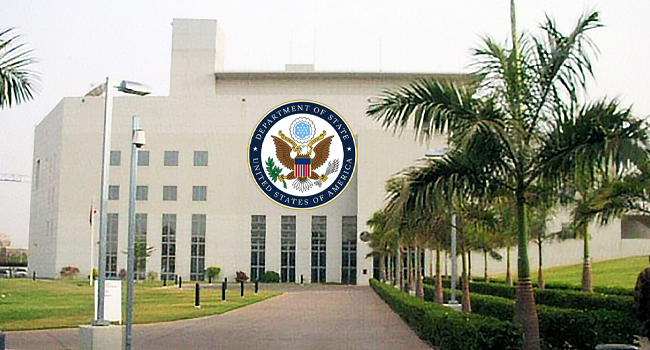
This was disclosed in an updated travel advisory issued by the U.S. Department of State, which said the move took effect on April 8, 2026, following a fresh review of the security situation in the country.
According to the advisory, Nigeria remains under a Level 3 warning, meaning Americans are urged to reconsider travel because of risks linked to crime, terrorism, unrest, kidnapping, and uneven access to healthcare.
Several states were also placed under the stricter Level 4 category, where travel is strongly discouraged.
The statement reads, “On April 8, 2026, the Department of State authorised non-emergency U.S. government employees and U.S. government employee family members to leave U.S. Embassy Abuja due to the deteriorating security situation.
“There were no changes to the Travel Advisory Level or risk indicators. Advisory summary was updated to reflect changes to U.S. embassy operations. Do not travel to Plateau, Jigawa, Kwara, Niger, and Taraba states.
“Reconsider travel to Nigeria due to crime, terrorism, unrest, kidnapping, and inconsistent availability of health care services. Some areas have an increased risk. Read the entire Travel Advisory.”
The department stressed that violent crime continues to be a major issue in different parts of the country.
Incidents such as armed robbery, assault, carjacking, kidnapping, and hostage-taking were specifically mentioned, with foreigners and dual nationals said to be frequent targets for ransom-related abductions.
It also warned that extremist groups, including Boko Haram, still pose a threat and may carry out attacks in crowded public places such as markets, schools, worship centres, government offices, and transport hubs.
In Northern Nigeria, Level 4 states that U.S. citizens should avoid Borno, Jigawa, Kogi, Kwara, Niger, Plateau, Taraba, Yobe, and northern Adamawa states due to terrorism, crime, and kidnapping.
The advisory also listed Bauchi, Gombe, Kaduna, Kano, Katsina, Sokoto, and Zamfara states, citing unrest, crime, and kidnapping.
The advisory stated, “The security situation in these states is unstable and uncertain due to civil unrest. Widespread violence between communities and armed crime, including kidnapping and roadside banditry.
“Security operations to counter these threats may occur without warning.”
In Southern and Southeastern Nigeria, the department urged citizens to avoid Abia, Anambra, Bayelsa, Delta, Enugu, Imo, and Rivers states, excluding Port Harcourt, due to crime, kidnapping, and unrest.
“Crime is widespread in Southern Nigeria. There is a high risk of kidnapping, violent protests, and armed gangs,” the advisory added.
Beyond the security risks, the advisory pointed to healthcare challenges, noting that access to medicines can be limited, emergency response services are often unreliable, and hospitals may demand payment before treatment.
The U.S. government further warned that its ability to help citizens in some high-risk locations may be very limited, advising Americans to stay away from those areas completely.
ALSO READ: US Missionary Alex Barbir Leaves Nigeria After Bashir Ahmad Called For His Arrest



![176 Women And Children Kidnapped From Kwara Community Begs For Help [Video]](https://media.kanyidaily.com/2026/04/09174317/Kwara-kidnapped-women-and-children-150x150.jpg "176 Women And Children Kidnapped From Kwara Community Begs For Help [Video] 5")


![“Afrobeats Don Scatter” – Teni Reacts To Wizkid And Burna Boy’s Clash [Video]](https://media.kanyidaily.com/2026/04/09104135/Teni-images-150x150.jpeg "“Afrobeats Don Scatter” – Teni Reacts To Wizkid And Burna Boy’s Clash [Video] 19")

![Emir Of Kaltungo In Gombe Seen Leading Christian Hymn [Video]](https://media.kanyidaily.com/2026/04/08174947/Screenshot_2026-04-08-12-19-14-289_com.android.chrome-edit_1775653383-1-150x150.jpg "Emir Of Kaltungo In Gombe Seen Leading Christian Hymn [Video] 23")



![Nigerian Students Kicks Off Nationwide Protest Over Increase In Electricity, Petrol Price [Photos] 4](https://media.kanyidaily.com/2020/09/08152448/Ibadan-protest-780x405-1.jpg "Nigerian Students Kicks Off Nationwide Protest Over Increase In Electricity, Petrol Price [Photos] 29")

![Drama As Nigerians Reject Okowa, VP Candidates During Arise TV Debate [Video]](https://media.kanyidaily.com/2022/11/07081119/Okowa.jpeg "Drama As Nigerians Reject Ifeanyi Okowa During Arise TV Debate [Video] 33")

!["I'm Suffering In Poverty Despite Having A Billionaire Brother" – Cubana Chief Priest's Brother Cries Out [Video]](https://media.kanyidaily.com/2024/06/01114103/Cubana-Chief-Priest.jpg "\"I'm Suffering In Poverty Despite Having A Billionaire Brother\" – Cubana Chief Priest's Brother Cries Out [Video] 37")

![Desmond Elliott Hits The Streets Of Lagos To Celebrate Tinubu’s Presidential Victory [Video]](https://media.kanyidaily.com/2023/03/01142811/desmond-elliot-tinubu.jpg "Desmond Elliott Hits The Streets Of Lagos To Celebrate Tinubu’s Presidential Victory [Video] 41")