World News
How Gaddafi’s Son, Saif Al-Islam Was Shot Dead At Home In Libya

Saif al-Islam Gaddafi, the son of former Libyan ruler Muammar Gaddafi, has reportedly been killed.
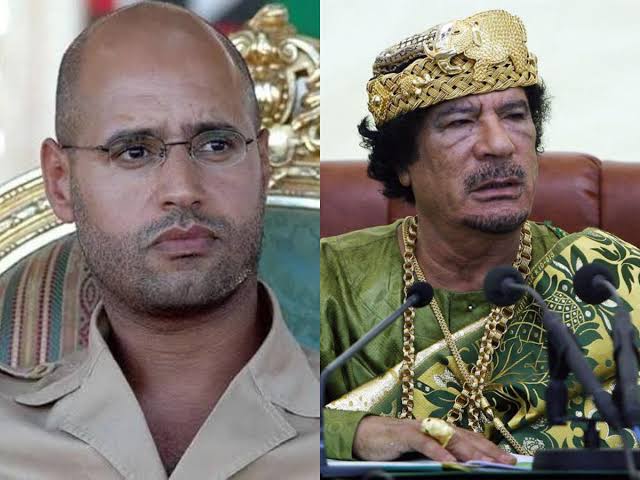
According to the Libyan News Agency, the 53-year-old’s death was confirmed on Tuesday by the leader of his political team.
His lawyer told AFP that a four-man armed group attacked his home in Zintan and carried out the killing, although it remains unclear who was responsible.
“Four masked men stormed his house and killed him in a cowardly and treacherous assassination”.
The statement said that he clashed with the assailants, who closed the security cameras at the house “in a desperate attempt to conceal traces of their heinous crimes”.
However, his sister gave a different account, telling Libyan television that he died near Libya’s border with Algeria.
For years, Saif al-Islam was regarded as one of the most powerful and controversial figures in Libya after his father, who ruled the country from 1969 until he was overthrown and killed during the 2011 uprising.
Born in 1972, he became a central figure in Libya’s efforts to rebuild ties with Western nations in the early 2000s, before the collapse of his father’s government.
After the regime fell, he was accused of playing a major role in the violent crackdown on anti-government protests in 2011.
A militia group in Zintan captured and detained him for nearly six years.
The International Criminal Court sought to prosecute him for alleged crimes against humanity linked to the suppression of protesters.
In 2015, a court in Tripoli sentenced him to death in absentia over his involvement in the crackdown.
At the time, Tripoli was under the control of the UN-backed administration.
Two years later, a militia in the eastern city of Tobruk released him under an amnesty law.
Since the fall of Muammar Gaddafi, Libya has remained politically unstable, divided between rival administrations and armed groups competing for control.
Although he never held an official government position during his father’s rule, Saif al-Islam played an active role in shaping policy and leading high-level negotiations.
He was involved in talks that led Libya to give up its nuclear weapons programme, a move that resulted in the lifting of international sanctions and improved relations with the West.
Some observers viewed him as a reform-minded figure who represented a new direction for the country.
He repeatedly denied plans to succeed his father, once saying that leadership was “not something to be passed down like property.”
In 2021, he announced his intention to run in the presidential election, which was later postponed indefinitely.
KanyiDaily recalls that former French president Nicolas Sarkozy was recently sentenced to five years in prison over allegations that lMuammar Gaddafi funded his presidential campaign in return for diplomatic favours.



![Police Arrest Four Officers Filmed Forcing Suspect Into Vehicle Boot In Imo [Video]](https://media.kanyidaily.com/2026/08/04150541/Screenshot-2026-08-04-at-12.45.38-PM-2026-08-04-874-1024x597-1-400x240.png "Police Arrest Four Officers Filmed Forcing Suspect Into Vehicle Boot In Imo [Video] 8")
![Police Arrest Four Officers Filmed Forcing Suspect Into Vehicle Boot In Imo [Video]](https://media.kanyidaily.com/2026/08/04150541/Screenshot-2026-08-04-at-12.45.38-PM-2026-08-04-874-1024x597-1-80x80.png "Police Arrest Four Officers Filmed Forcing Suspect Into Vehicle Boot In Imo [Video] 9")