President Bola Tinubu has presented a ₦58.47 trillion budget proposal for the 2026 fiscal year to a joint sitting of the National Assembly.
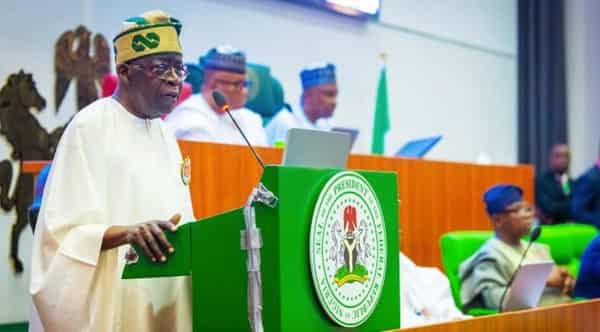
The budget was presented on Friday, with non-debt recurrent expenditure put at ₦15.25 trillion and capital spending set at ₦26.08 trillion.
The proposal is based on a crude oil price benchmark of $64.85 per barrel.
He said the expected total revenue is ₦34.33 trillion, projected total expenditure: ₦58.18 trillion, including ₦15.52 trillion for debt servicing. The budget is ₦23.85 trillion, representing 4.28% of GDP.
The proposal was anchored on a crude oil production of 1.84 million barrels per day, and an exchange rate of ₦1,400 to the US Dollar for the 2026 fiscal year.
[irp]
In terms of sectoral allocation, defence and security took the lion’s share with ₦ 5.41 trillion, followed by infrastructure at ₦3.56 trillion.
Education received ₦3.52 trillion, while health received ₦2.48 trillion in the proposal, titled “Budget of Consolidation, Renewed Resilience and Shared Prosperity”.
Speaking to lawmakers, Tinubu said the budget goes beyond figures on paper, describing it as a clear statement of the country’s priorities.
“They are a statement of national priorities,” the president told the gathering.
“We remain firmly committed to fiscal sustainability, debt transparency, and value‑for‑money spending.”
[irp]
The presentation comes amid growing security concerns across parts of the country, including rising cases of abductions and violent crimes.
Tinubu stressed that security remains central to national development.
He outlined steps being taken to tackle insecurity, including upgrading the armed forces, intelligence-led policing, joint security operations, stronger border control, technology-driven surveillance, and community-based peace initiatives.
“We will invest in security with clear accountability for outcomes—because security spending must deliver security results,” the president said in his address.
[irp]
“To secure our country, our priority will remain on increasing the fighting capability of our armed forces and other security agencies by boosting personnel and procuring cutting-edge platforms and other hardware.”
Reflecting on economic reforms introduced since he assumed office in May 2023, including the removal of fuel subsidy and the floating of the naira, Tinubu acknowledged the hardship Nigerians have faced.
He said those measures initially pushed inflation higher but insisted the economy has now begun to stabilise.
“I commend the understanding, sacrifice, and resilience of our people,” Tinubu stated.
“My administration remains committed to easing the burdens of transition and ensuring that the benefits of reform reach households and communities across the Federation.”
[irp]
The president also highlighted plans to boost infrastructure development and strengthen food security, which he described as key to attracting private investment.
“We will take decisive steps to strengthen agricultural markets. Food security is national security,” the president said.
“The 2026 Budget prioritises input financing and mechanisation; irrigation and climate‑resilient agriculture; storage and processing; and agro‑value chains.”
Tinubu added that these efforts are aimed at reducing post-harvest losses, increasing farmers’ incomes, expanding agro-industrial activities, and building a more resilient and diversified economy.
This comes barely 24 hours after President Bola Tinubu asked the Senate to approve his plan to present the 2026 budget to the National Assembly.
[irp]
![Peter Obi Reacts To Backlash Over His Wife’s Expensive Bag [Video]](https://media.kanyidaily.com/2026/09/15095957/Peter-Obi-wife-images.jpeg)





![“I'm A Product Of Luck” – Tony Elumelu Speaks On His Success [Video]](https://media.kanyidaily.com/2026/06/22095303/Tony-Elumelu.webp)