Politics
Can the President Suspend a Governor in Nigeria?

The recent declaration of a state of emergency in Rivers State by President Bola Ahmed Tinubu has sparked widespread debate, particularly over the purported suspension of Governor Siminalayi Fubara, his deputy, and members of the state’s House of Assembly. The Nigerian Bar Association (NBA) has strongly opposed this move, describing it as unconstitutional. This raises a critical question: Can the president suspend a governor in Nigeria?
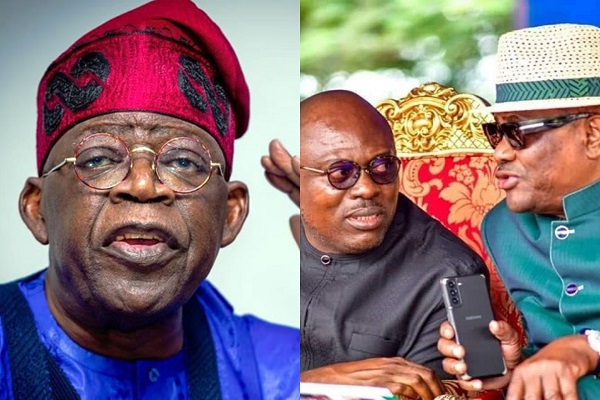
Does the Nigerian President have the power to suspend a governor?
What the Constitution Says?
Nigeria operates a constitutional democracy where powers are separated among the executive, legislative, and judicial arms of government. The removal of a governor is strictly guided by the 1999 Constitution (as amended), and no section grants the President the authority to suspend or remove an elected governor.
The relevant provisions of the Constitution include:
Section 305: This section empowers the President to declare a state of emergency but does not provide for the removal or suspension of elected officials.
Section 188: The process of removing a governor is clearly outlined under this section. It states that only the State House of Assembly, through an impeachment process, can remove a governor, and even then, it requires strict adherence to due process.
Legal Expert’s Opinion
Barrister Iheanyi Dick, a legal counselor, weighed in on the controversy, stating:
The President lacks the constitutional power to remove Governor Fugbara, an elected governor, under a state of emergency. The President’s declaration of emergency that purports to have done so, is an unconstitutional encroachment on democratic governance and the autonomy of state governments.
The declaration of a state of emergency in Rivers State was not preceded by any clear security justification, and lacks both legal and constitutional validity. It smacks of a “paddy paddy” support by the President for Nyesom Wike, his Minister of the FCT, in the latter’s brazen determination to throw Rivers State into a state of political comatose for not having his corrupt ways through direct show of advanced political thuggery and State-kidnapping. I condemn this abuse of emergency powers as a pawn in the political chessboard of Rivers State in particular and Nigeria, in general.
I therefore implore the National Assembly to reject any unconstitutional attempt to ratify the removal of the Rivers State Governor and other elected officials. The Constitution of Nigeria, which is our grundnorm, envisaged that the approval of a state of emergency must be based on strict constitutional grounds, not political expediency. Thus, it is a constitutional aberration to suspend elected officials under emergency rule as the President has done. Allowing the abuse of constitutional powers to stay would tantamount to giving room to a dangerous precedent that flies in the face of democracy and could be misused to unseat democratically elected governments in the future.
I also urge that all actions taken in Rivers State should be in tandem with Nigeria’s constitutional provisions and democratic norms.

NBA’s Position on the Suspension
The Nigerian Bar Association has strongly criticized the purported suspension of Governor Fubara and his deputy, calling it a breach of constitutional provisions. The NBA emphasized that:
- The Constitution does not empower the President to suspend or remove a governor.
- A declaration of emergency does not automatically dissolve elected state governments.
- The National Assembly must approve any state of emergency within a specific period for it to remain in effect.
- Political disputes should be resolved through legal and constitutional mechanisms, not executive directives.
Implications of an Unconstitutional Suspension
If the suspension of a governor under a state of emergency is allowed to stand, it sets a dangerous precedent that could be misused in the future. This would mean that any sitting President could declare an emergency in a state and remove an elected governor, eroding Nigeria’s democratic foundations and federal structure.
Moreover, such an action could lead to political instability, judicial battles, and increased distrust in the electoral process. It could also deter investors and stakeholders who value political stability in governance.
What Happens Next?
The matter is likely to be challenged in court, where the judiciary will interpret whether the President’s actions align with the Constitution. The National Assembly also has a role to play in determining the legality of the emergency rule.
Meanwhile, Former presidential candidate, Peter Obi has criticized President Bola Tinubu’s decision to suspend Rivers State Governor Siminalayi Fubara, calling it an unconstitutional and reckless act.
READ MORE: Tinubu’s Decision To Suspend Fubara Is Unconstitutional And Reckless – Peter Obi

![Suspected Thugs Block Peter Obi’s Convoy In Benue [Video]](https://media.kanyidaily.com/2026/09/08145917/IMG_1926-758x600-1-400x240.jpg "Suspected Thugs Block Peter Obi’s Convoy In Benue [Video] 7")
![Suspected Thugs Block Peter Obi’s Convoy In Benue [Video]](https://media.kanyidaily.com/2026/09/08145917/IMG_1926-758x600-1-80x80.jpg "Suspected Thugs Block Peter Obi’s Convoy In Benue [Video] 8")


![Arise TV Cuts Interview With Wike’s Aide, Lere Olayinka For Refusing To Answer Rufai Oseni's Question [Video]](https://media.kanyidaily.com/2026/09/04121532/ivgyy_1788512495-400x240.png "Arise TV Cuts Interview With Wike’s Aide, Lere Olayinka For Refusing To Answer Rufai Oseni's Question [Video] 13")
![Arise TV Cuts Interview With Wike’s Aide, Lere Olayinka For Refusing To Answer Rufai Oseni's Question [Video]](https://media.kanyidaily.com/2026/09/04121532/ivgyy_1788512495-80x80.png "Arise TV Cuts Interview With Wike’s Aide, Lere Olayinka For Refusing To Answer Rufai Oseni's Question [Video] 14")