World News
Israel Launches Airstrikes On Iran, Hits Nuclear Sites And Kills Top Military Officers

Israel carried out a large-scale military operation in Iran on Friday, targeting nearly 100 locations, including nuclear facilities and key military bases.
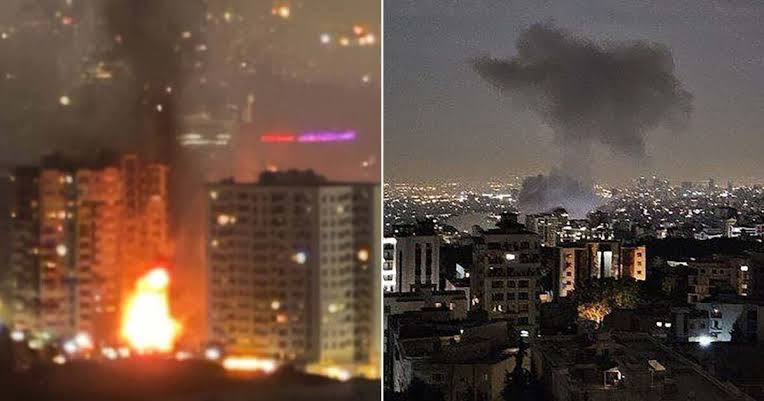
Among those killed were top-ranking Iranian officials, including the head of Iran’s armed forces and several senior nuclear scientists.
Iran’s Supreme Leader, Ayatollah Ali Khamenei, responded with a stern warning, promising that Israel would face a “bitter and painful” outcome.
Iran’s military also issued a strong statement, saying it had “no limits” in how it would respond.
In retaliation, Iran reportedly launched around 100 drones aimed at Israel, though the Israeli military said most were intercepted before reaching its territory.
Meanwhile, Jordan reported that it had taken down missiles and drones that had crossed into its airspace, triggering sirens in the capital, Amman.
Former U.S. President Donald Trump told Fox News he had been informed of Israel’s plans ahead of time.
He made it clear he believes Iran must not be allowed to develop a nuclear weapon.
Although the U.S. emphasized it had no role in the attack, Iranian officials accused Washington of being indirectly responsible, claiming such a major strike couldn’t have happened without American involvement.
Israeli Prime Minister Benjamin Netanyahu confirmed that the operation targeted Iran’s nuclear program, especially the facility in Natanz.
He stated the attacks would go on for “as many days as necessary,” claiming intelligence showed Iran was nearing a critical point in its nuclear development.
Iranian media reported that the airstrikes killed General Mohammad Bagheri, Iran’s military chief of staff, along with Hossein Salami, the leader of the Islamic Revolutionary Guard Corps.
Israel’s Defence Minister, Israel Katz, said the mission was a clear message to anyone planning Israel’s destruction—they will be eliminated.
Photos from AFP showed a high-rise in Tehran with a massive hole, suggesting a direct hit.
Iranian state media also reported civilian casualties, including women and children.
Six nuclear scientists were reportedly killed, according to the Tasnim news agency.
Tehran streets were eerily quiet, with long lines forming at petrol stations. Flights at Tehran’s Imam Khomeini International Airport were halted.
Iraq and Jordan also closed their airspace, while several Gulf airlines suspended flights to and from Iran and its neighboring countries.
Israel declared a state of emergency and shut its own airspace.
Defence officials said they were preparing for further retaliation. Hours later, Jordan said it had intercepted more missiles and drones over its territory.
Iran’s armed forces called the strike a serious escalation, warning Israel had crossed a red line and that the response would be severe.
Global markets reacted quickly. Oil prices jumped, and stocks dipped sharply as the news spread.
Trump, speaking again, warned of a potential “massive conflict” in the region and said the U.S. was withdrawing some personnel from its Middle East bases due to threats from Iran.
Before the attack, Trump had expressed hope that a new nuclear deal with Iran was close but acknowledged that Israeli military action could disrupt that process.
He told Fox News that a recent conversation with Netanyahu left him concerned, adding, “I don’t want them going in, because I think it would blow it,” though he later added, “Might help it actually.”
U.S. Secretary of State Marco Rubio cautioned Iran not to retaliate against American troops or bases, insisting the U.S. wasn’t part of the Israeli operation.
The International Atomic Energy Agency (IAEA) confirmed that the Natanz nuclear site was hit and said it was monitoring the situation closely, including radiation levels, and was in contact with Iranian officials and its own inspectors in the country.
Israel has long seen Iran as a major threat to its existence. Netanyahu has taken a more aggressive stance since the October 7, 2023, attack by Hamas, a group backed by Iran, which led to a major military response in Gaza.
Since then, tensions between Israel and Iran have escalated to direct confrontations, with Israel also fighting against Iran’s allies in Lebanon (Hezbollah) and Yemen (the Houthis).
The West and Israel have frequently accused Iran of trying to build a nuclear weapon, a claim Tehran denies.
Following recent criticism from the IAEA over non-compliance, Iran dismissed the agency’s claims and said it plans to build a new uranium enrichment facility in a secure location.
Iran is now enriching uranium at 60% purity—far above the 3.67% limit set in the 2015 nuclear deal, and getting closer to the 90% needed to make a nuclear bomb.
KanyiDaily recalls that in 2024, Iran fired around 200 missiles at Israel in retaliation for an Israeli airstrike in Beirut that killed Hezbollah leader Hassan Nasrallah and Iranian General Abbas Nilforoushan.