World News
US President Trump Imposes 15% Tariff On Nigeria In New Global Trade Push

Nigeria and several other African countries have been hit with a new 15% import tariff following an executive order signed by the United States President Donald Trump.
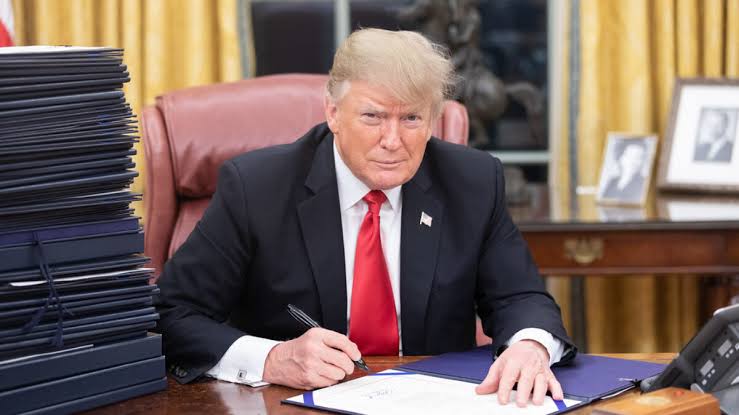
The announcement came on Thursday, July 31, as part of a broader overhaul of U.S. trade policy.
Earlier in April, Trump had introduced a 14% tariff on Nigerian goods, but enforcement was delayed for 90 days to allow room for one-on-one trade negotiations.
The grace period ended on August 1, and with little progress in talks, the new tariffs have now been enforced.
Despite multiple discussions, no African country was able to finalize a trade agreement with the U.S., leaving the continent fully exposed to the new tariff rates.
In the same timeframe, Trump also imposed travel restrictions on some African countries initially excluding Nigeria, but later adding it as the policy evolved.
Nigeria’s Minister of Foreign Affairs, Yusuf Tuggar, commented that West African countries were eager to strengthen trade with the U.S., but said the travel bans made progress difficult.
Under the revised system, countries were grouped by tariff rates:
- 10% – Falkland Islands, United Kingdom, and all other countries not listed in the executive order
- 15% – Afghanistan, Angola, Bolivia, Botswana, Cameroon, Chad, Costa Rica, Côte d`Ivoire, Democratic Republic of the Congo, Ecuador, Equatorial Guinea, Fiji, Ghana, Guyana, Iceland, Israel, Japan, Jordan, Lesotho, Liechtenstein, Madagascar, Malawi, Mauritius, Mozambique, Namibia, Nauru, New Zealand, Nigeria, North Macedonia, Norway, Papua New Guinea, South Korea, Trinidad and Tobago, Turkey, Uganda, Vanuatu, Venezuela, Zambia, Zimbabwe
- 18% – Nicaragua
- 19% – Cambodia, Indonesia, Malaysia, Pakistan, Philippines
- 20% – Bangladesh, Sri Lanka, Thailand, Taiwan, Vietnam
- 25% – Brunei, India, Kazakhstan, Moldova, Tunisia
- 30% – Algeria, Bosnia and Herzegovina, Libya, South Africa
- 35% – Iraq, Serbia
- 39% – Switzerland
- 40% – Laos, Myanmar (Burma)
- 41% – Syria
Mexico was slapped with a 25% tariff on cars and fentanyl-related products, plus a 50% rate on metals like steel, aluminum, and copper — all to take effect in 90 days.
Brazil, initially hit with a 10% tariff, was later subjected to a new 40% duty, pushing its total rate to 50%.
Meanwhile, trade talks between the U.S. and China remain ongoing, as both sides continue negotiations in a long-running dispute.
KanyiDaily recalls that the Minister of Foreign Affairs, Yusuf Tuggar recently revealed that President Donald Trump is pressurizing Nigeria to accept Venezuelan deportees from the United States.